
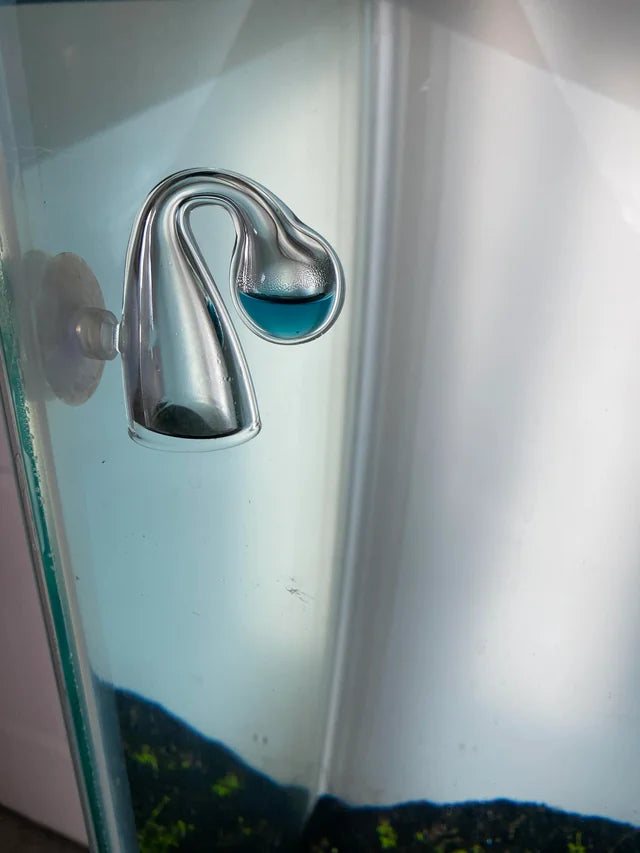
CO2 injection adds dissolved carbon dioxide to aquarium water so plants can photosynthesise at the rate their light and nutrients already allow. In a planted tank carbon is usually the factor running out first, so a steady supply speeds growth, fills leaves out and leaves algae less room. A working setup needs a regulator, a diffuser and a way to read the level in the water.
What does CO2 injection do for aquarium plants?
Plants build tissue from carbon, and in water carbon is scarce. The surface exchanges gas slowly, so a tank full of healthy stems can strip the water of free carbon dioxide within hours of the lights coming on. Injection puts that carbon back at a steady rate, which lets a plant use the light and the nutrients it already has instead of idling.
What you see afterwards is not a different plant but a faster one. Nodes shorten, new leaves come in larger and firmer, red stems colour up, and carpeting species start to run sideways instead of upward. Plants that were merely holding on begin to compete for nutrients and light — and in a planted tank, plants that compete well are the cheapest algae control there is.
The reverse is just as plain. When injection stops, growth slows first, then the oldest leaves thin and algae move onto them. Steadiness matters more than generosity: plants settle into the level they are given, so a tank that swings between plenty and nothing is harder to keep clean than a tank that never had injection at all.

Do all aquarium plants need CO2 injection?
No. A large part of the aquarium plant trade grows without it, and some of the best low-tech tanks never inject at all. What injection decides is pace and ceiling: without it, slow growers do well and demanding species survive without ever filling in; with it, nearly everything on the shelf becomes possible.
Plants that do well without injection
These are the tough, slow or shade-tolerant species that take carbon from a low concentration and are not in a hurry. They are also the plants to build a first planted tank from, because they forgive an uneven supply.
- Anubias, Java fern and Bolbitis, attached to wood or rock
- Cryptocoryne species, which fill in slowly and resent being moved
- Vallisneria and Hygrophila, which spread on their own
- Mosses and Microsorum varieties, which tolerate shade
Plants that need injection to look right
Carpets and fast stems have the growth rate to use extra carbon, which is exactly why they stall without it. Under bright light with no injection they tend to grow thin, pale and open — the gap where algae establish first.

Mixing the two groups is where people get caught. A carpet under strong light with no injected supply is the classic recipe for a sparse lawn with algae in it, while the same light over Anubias and Cryptocoryne causes no trouble.
- Carpeting species such as Monte Carlo, dwarf hairgrass and HC Cuba
- Fast coloured stems such as Rotala, Ludwigia and Alternanthera reineckii
- Fine-leaved specialities such as Riccia and Utricularia
| Plant | Without CO2 injection | With CO2 injection |
|---|---|---|
| Anubias | Slow and steady, tolerates shade | Faster new leaves, cleaner old ones |
| Java fern | Reliable, needs no injection | Broader leaves, quicker runners |
| Cryptocoryne | Fills in slowly, very forgiving | Denser crowns, stronger colour |
| Vallisneria | Spreads well on its own | Spreads faster, taller blades |
| Amazon sword | Grows, but leaves stay small | Large firm leaves when fed as well |
| Rotala | Leggy and often pale | Compact nodes and full colour |
| Monte Carlo | Patchy carpet, algae-prone | Runs sideways into a dense carpet |
| HC Cuba | Rarely carpets, melts under strong light | Tight carpet that pearls |
| Dwarf hairgrass | Sparse, slow to spread | Fast runners, even lawn |
| Alternanthera reineckii | Dull colour, slow growth | Deep red with steady growth |
What a CO2 injection setup for planted tanks includes
A CO2 injection system is a short chain and every link has one job. A cylinder holds the gas. A regulator brings cylinder pressure down to a working pressure the rest of the gear can use and holds it there — a dual stage regulator with an integrated solenoid keeps that output steady as the cylinder empties, which is what prevents an end-of-cylinder dump. A needle valve sets the rate and a bubble counter lets you see it.
From there the gas needs CO2-rated tubing and a check valve: ordinary silicone airline lets carbon dioxide escape through its wall, and the valve stops water siphoning back toward the regulator. Then comes the diffuser, which breaks the gas into a mist fine enough to dissolve before it reaches the surface.
Last is the part most people skip. Something has to report the level in the water rather than at the valve, and a drop checker set does it by colour, from a glass chamber of pH indicator solution hung in the tank. A timer, or the solenoid's own schedule, completes the set.
How much CO2 do planted aquariums need?
There is a usual target for dissolved CO2 in a planted tank, and it is quoted as a concentration in the water — about 30ppm — never as a bubble count. Bubbles are a dial, not a measurement: the same count means different things in two tanks, because volume, flow, surface agitation and plant mass all change how much of the gas stays dissolved.

Two readings are used in practice. A drop checker filled with fresh indicator solution turns green when the dissolved level sits in the usual range, blue when there is too little and yellow when there is too much; it lags the tank by a few hours, which makes it good for the day's average and useless for catching a sudden change. The second reading is pH: let a glass of tank water stand until it degasses, measure it, then compare with the tank during the lit hours. A drop of roughly 1 pH unit corresponds to the usual target.
Climb slowly either way. Raise the rate a little, wait a day, then look at the plants and watch the fish near the surface in the last hour before lights out, which is when the dissolved level peaks.
How long should CO2 run each day?
CO2 runs with the lights, not around the clock. Plants take carbon up only while they are photosynthesising; in darkness they release it instead, so injecting at night wastes gas and pushes the level toward the point where fish are affected. A solenoid on a timer settles this without anyone having to think about it.
The usual schedule starts the gas about 1 hour before the lights, so the water is already at level when photosynthesis begins, and stops it about 1 hour before lights out, letting the tank coast through the end of the day. Overnight, surface agitation brings the dissolved level back down and oxygen back up.
Keep the schedule the same every day. Plants adapt to whatever they are given, and the quickest way to invite algae into a healthy tank is to change the carbon supply from one week to the next.
In-tank or inline: getting CO2 to every plant
Dissolving the gas is only half the job — the water has to carry it to the leaves. A plant at the far end of a tank with weak circulation can sit in carbon-poor water while the drop checker beside the diffuser reads green. Aim for gentle whole-tank flow: enough that the plants sway, not enough to lift the substrate.
Inline diffusers
An inline atomizer fits into the outlet hose of an external canister filter, so nothing is visible in the aquarium and the filter's return spreads the mist along its whole length. It has to match the filter's hose size, and it needs a working pressure of at least 40 psi, which a dual stage regulator supplies comfortably.
In-tank diffusers
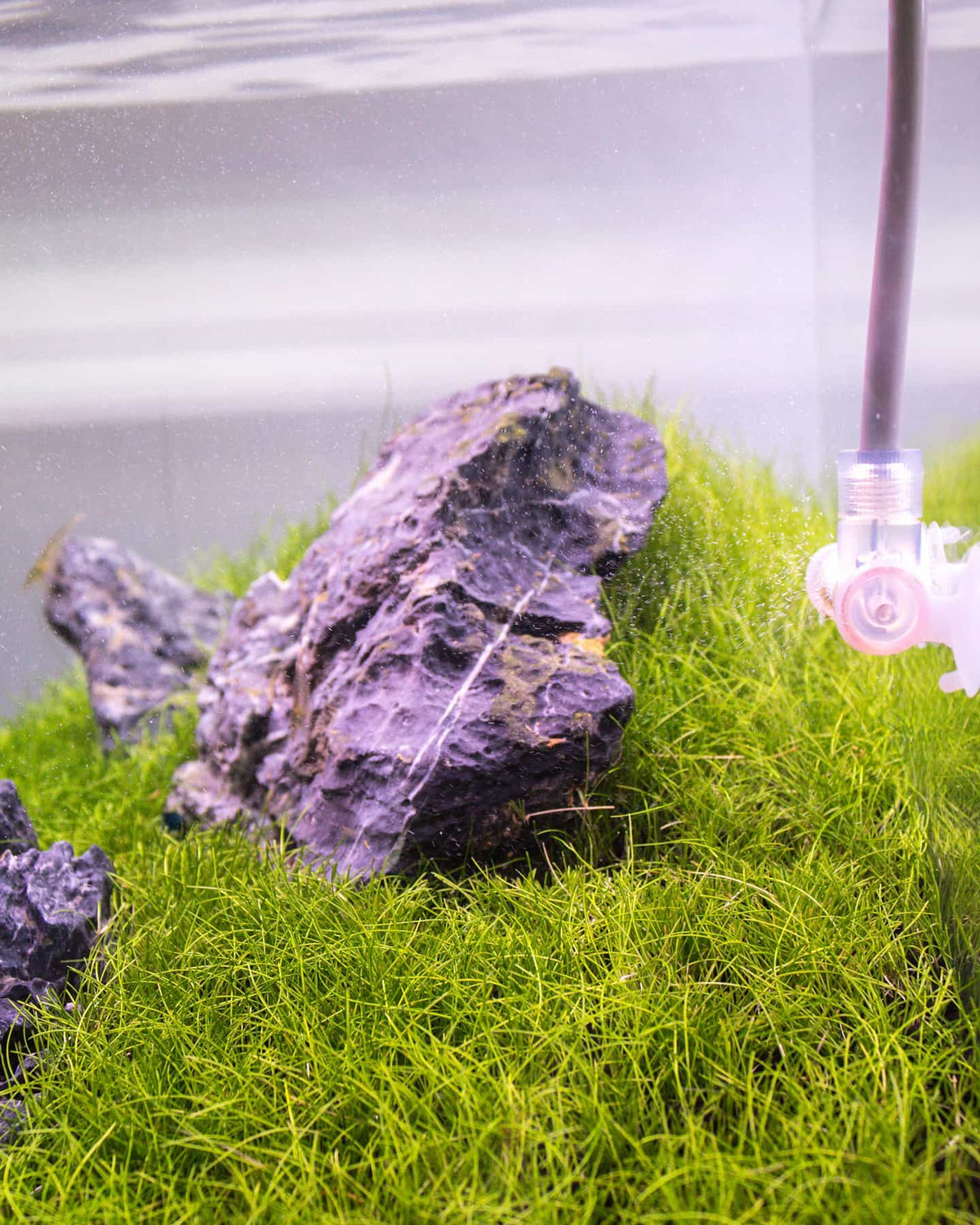
An in-tank Bazooka Flux diffuser mounts inside the aquarium — CO2 tubing onto the inlet, safety nut tightened — which makes it the simpler install and the easier one to clean. Set it low and on the side the flow starts from, so the mist crosses the tank before it surfaces. It comes in a smaller and a larger version, split at about 150 litres, and wants a starting pressure of roughly 40 psi.
Starting CO2 injection on an established planted tank
An established tank does not need its final rate on the first day, and it does better without it. Fish and shrimp have to adjust, and so does the plant mass, which cannot use carbon it has not yet grown into. Work up in steps, changing one thing at a time.
- Fit the regulator to the cylinder with its washer, tighten it on the thread by hand, then open the cylinder valve fully.
- Set the working pressure to what your diffuser asks for, close the needle valve, then open it slowly until the bubble counter shows a slow, countable stream.
- Hang the drop checker in the tank with fresh indicator solution, away from the diffuser, and read it the following afternoon.
- Raise the rate in small steps, no more than once a day, until the solution stays green through the lit hours.
- Watch the fish in the last hour of the photoperiod for a day or two after every change.
- Raise light and fertiliser only once the carbon supply is steady — in that order, never both together.
- Brush soapy water over the washer and every joint in the first week; a slow leak shows up as a cylinder that empties for no reason.
Common CO2 injection problems in planted tanks
- Plenty of bubbles, no growth — usually flow or light rather than carbon. Check that the mist reaches the far end of the tank before raising the rate.
- Algae soon after a change — the plants stalled while something else moved. Hold everything steady for a fortnight before adjusting again.
- Fish at the surface late in the photoperiod — too much dissolved CO2. Cut the rate, increase surface agitation and look again at the schedule.
- The level drifts down over a week — a leak at the washer or a cylinder nearing empty. A single stage regulator will also release its last gas unevenly as the cylinder empties.
- The drop checker never changes colour — stale solution, or it was filled with tank water instead of indicator solution.
- Pearling at lights on and nothing by evening — the supply is no longer keeping up with the plant mass the tank has grown.
Frequently asked questions
Do aquarium plants really need CO2 injection?
No — many grow well without it. Injection sets the pace and the ceiling. Slow growers such as Anubias, Java fern and Cryptocoryne are fine on their own, while carpets and fast red stems rarely fill in or colour up properly without an injected supply.
Which plants benefit most from CO2 injection?
Carpeting species such as Monte Carlo, dwarf hairgrass and HC Cuba, and fast stems such as Rotala, Ludwigia and Alternanthera reineckii. They have the growth rate to use the extra carbon, so they show the difference within weeks of a steady supply.
How do I know my plants are getting enough CO2?
Read the water, not the bubble counter. A drop checker with fresh indicator solution should sit green through the lit hours; blue means too little and yellow too much. Comparing tank pH with a degassed sample of the same water gives the same answer more precisely.
Can CO2 injection harm fish and shrimp?
It can, if the rate is raised quickly or the gas runs at night. Dissolved CO2 peaks at the end of the photoperiod, so change the rate in small steps, keep the surface moving and shut the supply off with the lights.
Should CO2 run at night in a planted aquarium?
No. Plants take carbon up only in the light, so night injection wastes gas and pushes the dissolved level toward the point where fish are affected. A solenoid on a timer turns the supply off with the lights and on again before them.
If you would rather not match the parts yourself, our complete CO2 kits arrive as one set — tell us the aquarium size and what you grow, and we will point you to the right regulator and diffuser.

Share:
How to Clean a Clogged CO2 Diffuser in a Planted Aquarium